








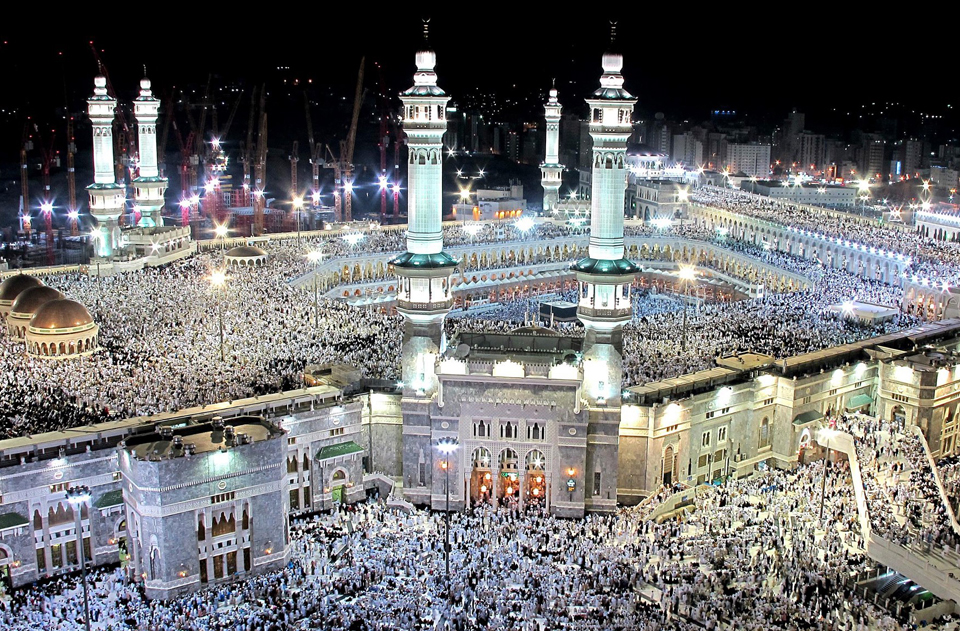
| 185. The month of Ramadan in which was revealed the Quran, a guidance for mankind and clear proofs for the guidance and the criterion (between right and wrong). So whoever of you sights (the crescent on the first night of) the month (of Ramadan, i.e., is present at his home), he must observe sawm (fasting) that month, and whoever is ill or on a journey, the same number [of days which one did not observe sawm (fasting) must be made up) from other days. Allah intends for you ease, and He does not want to make things difficult for you. (He wants that you) must complete the same number (of days), and that you must magnify Allah [i.e., to say Takbir (Allahu Akbar: Allah is the Most Great)) for having guided you so that you may be grateful to Him. |
| The Suhuf (Pages) of Ibrahim were revealed during the first night of Ramadan. The Torah was revealed during the sixth night of Ramadan. The Injil was revealed during the thirteenth night of Ramadan. Allah revealed the Quran on the twenty-fourth night of Ramadan.[1] |
The Virtues of the Quran
Allah said:
| a guidance for mankind and clear proofs for the guidance and the criterion (between right and wrong). |
Here Allah praised the Quran, which He revealed as guidance for the hearts of those who believe in it and adhere to its commands. Allah said:
| and clear proofs |
meaning, as clear and unambiguous signs and unequivocal proof for those who understand them. These proofs testify to the truth of the Quran, its guidance, the opposite of misguidance, and how it guides to the straight path, the opposite of the wrong path, and the distinction between the truth and falsehood, and the permissible and the prohibited.
The Obligation of Fasting Ramadan
Allah said:
| So whoever of you sights (the crescent on the first night of) the month (of Ramadan, i.e., is present at his home), he must observe Sawm (fasting) that month. |
This Ayah requires the healthy persons who witness the beginning of the month, while residing in their land, to fast the month. This Ayah abrogated the Ayah that allows a choice of fasting or paying the Fidyah. When Allah ordered fasting, He again mentioned the permission for the ill person and the traveler to break the fast and to fast other days instead as compensation. Allah said:
| and whoever is ill or on a journey, the same number [of days which one did not observe sawm (fasting) must be made up) from other days. |
This Ayah indicates that ill persons who are unable to fast or fear harm by fasting, and the traveler, are all allowed to break the fast. When one does not fast in this case, he is obliged to fast other days instead. Allah said:
| Allah intends for you ease, and He does not want to make things difficult for you. |
This Ayah indicates that Allah allowed such persons, out of His mercy and to make matters easy for them, to break the fast when they are ill or traveling, while the fast is still obligatory on the healthy persons who are not traveling.
Several Rulings concerning the Fast
The authentic Sunnah states that Allahs Messenger ﷺ traveled during the month of Ramadan for the battle for Makkah. The Prophet ﷺ marched until he reached the area of Kadid and then broke his fast and ordered those who were with him to do likewise. This was recorded in the Two Sahihs[2] Breaking the fast mentioned in this Hadith was not required, for the Companions used to go out with Allahs Messenger ﷺ during the month of Ramadan, then, some of them would fast while some of them would not fast and neither category would criticize the others. If the command mentioned in the Hadith required breaking the fast, the Prophet ﷺ would have criticized those who fasted. Allahs Messenger ﷺ himself sometimes fasted while traveling. For instance, it is reported in the Two Sahihs that Abu Ad-Darda said,
| We once went with Allahs Messenger ﷺ during Ramadan while the heat was intense. One of us would place his hand on his head because of the intense heat. Only Allahs Messenger ﷺ and Abdullah bin Rawahah were fasting at that time.[3] |
We should state that observing the permission to break the fast while traveling is better, as Allahs Messenger ﷺ said about fasting while traveling:
| Those who did not fast have done good, and there is no harm for those who fasted. [4] |
In another Hadith, the Prophet ﷺ said:
| Hold to Allahs permission that He has granted you.[5] |
Some scholars say that the two actions are the same, as Aishah narrated that Hamzah bin Amr Al-Aslami said, 0 Messenger of Allah! I fast a lot, should I fast while traveling?The Prophet ﷺ said:
| Fast if you wish or do not fast if you wish |
This Hadith is in the Two Sahihs [6 ]It was reported that if the fast becomes difficult (while traveling), then breaking the fast is better. Jabir said that Allahs Messenger ﷺ saw a man who was being shaded (by other people while traveling). The Prophet asked about him and he was told that man was fasting. The Prophet ﷺ said:
| It is not a part of Birr (piety) to fast while traveling. |
This was recorded by Al-Bukhari and Muslim.[7]
As for those who ignore the Sunnah and believe in their hearts that breaking the fast while traveling is disliked, they are required to break the fast and are not allowed to fast.
As for making up for missed fasting days, it is not required to be consecutive. One may do so consecutively or not consecutively. There are ample proofs to this fact. We should mention that fasting consecutive days is only required exclusively during Ramadan. After the month of Ramadan, what is required then is to merely make up for missed days. This is why Allah said:
| the same number (should be made up) from other days. |
Ease and not Hardship
Allah then said:
| Allah intends for you ease, and He does not want to make things difficult for you. |
Imam Ahmad recorded Anas bin Malik saying that Allahs Messenger ﷺ said:
| Treat the people with ease and dont be hard on them; give them glad tidings and dont fill them with aversion. |
This Hadith was also collected in the Two Sahihs.[8 ] It is reported in the Sahihayn that Allahs Messenger ﷺ said to Muadh and Abu Musa when he sent them to Yemen:
| Treat the people with ease and dont be hard on them; give them glad tidings and dont kill them with aversion; and love each other, and dont differ.[9] |
The Sunan and the Musnad compilers recorded that Allahs Messenger ﷺ said:
| I was sent with the easy Haniffiyyah (Islamic Monotheism). [10] |
Allahs statement:
| Allah intends for you ease, and He does not want to make things difficult for you. (He wants that you) must complete the same number (of days) |
means: You were allowed to break the fast while ill, while traveling, and so forth, because Allah wanted to make matters easy for you. He only commanded you to make up for missed days so that you complete the days of one month.
Remembering Allah upon performing the Acts of Worship
Allahs statement:
| and that you must magnify Allah [i .e., to say Takbir (Allahu Akbar: Allah is the Most Great)) for having guided you |
means: So that you remember Allah upon finishing the act of worship. This is similar to Allahs statement:
| So when you have accomplished your Manasik, (rituals) remember Allah as you remember your forefathers or with far more remembrance. (2:200) |
and:
| Then when the (Jumuah) Salah (prayer) is ended, you may disperse through the land, and seek the bounty of Allah (by working), and remember Allah much, that you may be successful. (62:10) |
and:
| .and glorify the praises of your Lord, before the rising of the sun and before (its) setting. And during a part of the night, glonfy His praises, and after the prayers. (50:39, 40) |
This is why the Sunnah encouraged Tasbih (saying Subhan Allah, i.e., all praise is due to Allah), Tahmid (saying Al-Hamdu lillah, i.e., all the thanks are due to Allah) and Takbir (saying Allahu Akbar, i.e., Allah is the Most Great) after the compulsory prayers. Ibn Abbas said, We used to know that Allahs Messenger ﷺ has finished the prayer by the Takbir.[11]
Similarly, several scholars have stated that reciting Takbir the during Id-ul-Fitr was specified by the Ayah that states:
| (He wants that you) must complete the same number (of days), and that you must magnify Allah [i.e., to say Takbir (Allahu Akbar: Allah is the Most Great)) for having guided you… |
Allahs statement:
| so that you may be grateful to Him. |
means: If you adhere to what Allah commanded you, obeying Him by performing the obligations, abandoning the prohibitions and abiding by the set limits, then perhaps you will be among the grateful.
This article was extracted from Tafsir Ibn Kathir Volume 1: Dar-Us-Salam Publications
Footnotes
[1] Ahmad4:107
[2] Fath Al-Bari 3 :213, Muslim 2:784.
[3] Path Al-Bari 4 :215, and Muslim 2:790.
[4] Muslim 2 :790.
[5] Muslim 2:786.
[6] Fath Al-Bari 4:211, and Muslim 2:789.
[7] Fath Al-Bari 4:216, and Muslim 2:786.
[8] Ahmad 3:131, and 209, Fath Al-Bari 10:541, and Muslim 3:1359.
[9] Fath Al-Bari 7:660, Muslim 3:1587.
[10] Ahmad 5:266.
[11] Sahih Al-Bukhari no. 842.





MOST POPULAR



FEATURED













SUBSCRIBE AND LEARN...
- Fresh articles
- Increase your Islamic knowledge
- Build a Powerful Connection with Allah