








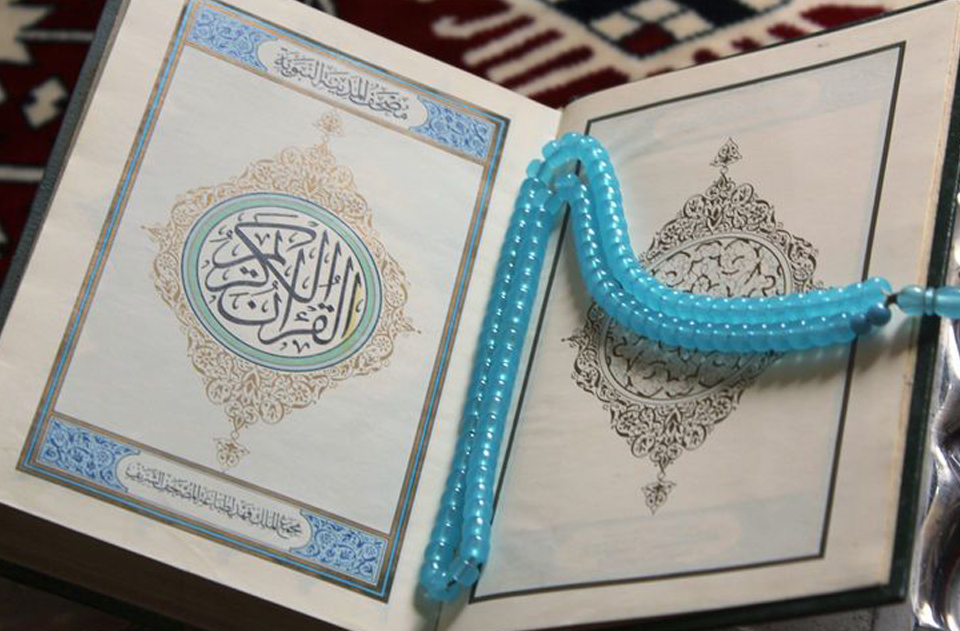
We all feel touched when we open up a good translation of the meaning of the Quran and we ponder and wonder at the beauty of the words and the deep meanings within. But in reality, we are just seeing a glimpse of the real treasure that the Quran is.
Imagine how you’d feel if you could understand the words of Allah in the form in which they were sent down and not just rely on a translation of the meaning in English. Imagine the power of the words and the directness of the message then! The potency would be awesome!
The Quran is the word of Allah; a direct message from Allah to us His creation and Allah chose the Arabic language as the language of this message. Indeed, Allah tells us this in the Quran emphasising to us that to understand the message in its fuller form one must understand the language:
| Indeed we have sent it down as an Arabic Quran, in order that you may understand (Surah Yusuf, Aayah 2) |
| And thus we have inspired to you an Arabic Quran so that you may warn the mother of towns and all around it (Surah ash-Shura, 7) |
| And if you are in doubt about what we have sent down to our servant, then produce a chapter like it and call your witnesses besides Allah if you are truthful. But if you do not do it, and you can never do it, then fear the Fire whose fuel is men and stones, prepared for the disbelievers (Surah Baqarah, aayaat 23-24) |
The Preservation of the Arabic Language
Languages usually evolve. Just look at the difference between Shakespearean English and modern day English. In many ways, they seem like two totally different languages and a man from England in Shakespearean times and a man from modern day England would find it extremely difficult to communicate! But the Arabic language is not just a language. This is why the Sahabah and the early generations of Muslims strove to preserve the classical Arabic language. It was Ali (radi Allahu anhu) who noticed on the tongues of some of the Arabs a slight change in dialect and ordered for the grammar rules of Arabic to be recorded in a universal form. He knew that the preservation of the Arabic language was part of the preservation of Islam itself. Arabic unified the Muslim countries as it spread to every land that embraced Islam. This is why it is seen that those Muslim societies that are ignorant of Arabic are in general less knowledgeable about Islam. This ignorance has in turn made them more prone to stray from the straight path.
The enemies of Islam know this and have worked hard to tear the Muslims from the Arabic language and the Quran. During the French occupation of Algeria, the French government was advised,
| We will never be able to overpower the Algerians as long as they read the Quran and speak Arabic. Therefore, we must remove the Arabic Quran from their midst and abolish the Arabic language from their tongues. |
And unfortunately, this is exactly what the secular leader of Turkey, Kamal Ataturk, who abolished the Islamic caliphate, did. He ordered that the Quran be recited in Turkish, even in prayers and changed the Turkish language which used to be written in Arabic into a Latin alphabet.
Today you will find that although Arabs throughout the world unfortunately have different colloquial dialects, they are still taught the Classical Arabic in their schools and Classical Arabic is the standard written Arabic in every Arabic newspaper and book. So, it has been preserved by Allah as He promised in the Quran:
| Indeed we have sent down the Reminder and surely we will preserve it. (Surah Hijr, Aayah 9) |
A Priority for all of us
Scholars throughout the ages, from the Companions to the present day, encouraged the Ummah to learn the Arabic language. Ubay ibn Kab (radiAllahu anhu) said,
| Teach Arabic like you teach the memorisation of the Quran! |
Abu Bakr (radiAllahu anhu) said,
| That I recite and forget (a portion of the Quran) is more beloved to me than to make a grammatical mistake! |
And Umar (radiAllahu anhu) once passed by a group of archers who missed their targets:
| He admonished them and they responded that they were only beginners, but in answering back they made a grammatical mistake in their wording. He told them, indeed, your mistakes in Arabic grammar are more difficult to bear than your mistakes in archery! |
Imam ash-Shaafiee said,
| “Therefore it is imperative that every Muslim should strive to learn Arabic as hard as he can, so that he can testify the shahada, and recite the Book of Allah and say the invocations that are mandatory upon him, such as the takbeer, tasbeeh, tashahud and other prayers. And the more he learns the language that Allah Himself chose to be the language of him who sealed the Prophets (sallAllahu alaihi wa sallam), and to be the language of His final revelation, the better it is for him! |
The great 8th century scholar Shaykul Islam Ibn Taymiyyah (rahimahullah) even went so far as to say that,
| The Arabic language is part of the Religion, and knowing it is an obligation. |
Unfortunately, we have become comfortable with simply relying on translations and spending all of our time and efforts in studying other things, (other languages even!) which may not even benefit us in the hereafter and have forgotten that the Quran is in a very approachable language and we all have the ability or rather the responsibility to study and understand it. If you knew that Allah (subhaanahu wa taaala) had a message for you, personally, then would you not want to understand it in its original form? Think about it we have the last revelation to mankind, the only communication from our Lord and Master, which is preserved in its original form, and yet in a 70-odd year life we do not give it the attention, which it deserves. We should realise that Allah has honoured us with the Quran and chosen for us the noblest of languages. Attention to Arabic is attention to the Book of Allah so we should make learning it a priority.
I remember the feeling of tasting the sweetness of Allah’s words in my Salaah when I first embarked upon my Arabic studies. I just repeated the same aayah of the Quran again and again savouring the words and suddenly feeling a deep emotion that I’d never felt before though I had read the same aayah many times before studying Arabic, it was as though a light had been lit for me and I’d suddenly discovered a new part of a house that I’d been living in for years. One of the definite benefits of learning Arabic is that it aids Khushoo or consciousness in salaah and helps us to improve all of our worships. Taraweeh prayer in Ramadan becomes a new experience!
Practical steps towards learning Arabic
Alhamdulillah with all the teaching aids and easy access to information that we have, learning Arabic does not necessarily mean travelling on arduous journeys to distant lands as it once used to. With discipline and commitment, the student can study much in his own time.
Here are some tips to help you along the way:
1. Make Dua: As with everything we work towards, we should ask Allah to help us and make learning easy for us. We should ask Allah to purify our intentions so that we truly learn Arabic for the better understanding of the Quran and deen.
2. Discipline yourself! Put a set amount of time aside every day or twice a week for your Arabic studies and stick to it. Remember a little study regularly is better than hours of study once a month.
3. Know your basics well: going step by step is the best way to master any language, concentrating on improving your basic reading and writing is the first step in learning Arabic, even if it is repetitive. Then you can build on that firm foundation.
4. Invest in a good dictionary and Arabic books: A good dictionary is the Hans Wehr or Al-Mawrid dictionary, available in most Muslim bookshops and on the Internet too! Arabic words are usually arranged under their three letter roots. Get used to looking up words often and compile your own personal vocabulary dictionary. Some good three-book sets you can start working through are the three Madinah university books or the Kitaab-ul Asaasi books.
5. Enrol into a summer course: There are a few around every summer and they are a great way to kick-start your learning. They can be quite intensive so remember to revise and keep up your study afterwards.
6. Study Arabic as part of your full-time degree: If you are going to study a degree, why not study a degree in Arabic or one with Arabic as part of it?
7. Study under an Arab friend or tutor: The importance of a good teacher cannot be stressed enough. Although there is a lot of self-study involved, a friend who knows Arabic or an Arab brother or sister who you could go to regularly for guidance would be very valuable. You could even start going through your Arabic books with them.
8. Organise a class locally: There must be like-minded Muslims in your area who would like to study Arabic too. Maybe you could get together and pay for a teacher to teach you Arabic together at the local Masjid or in one of your homes. Studying with friends is a good way to stay motivated.
9. Study abroad in an Arab country: there are various good courses running in countries such as Egypt which really speed up your learning and can provide you with a nice experience. People have found that a few months in an Arab country can be more beneficial than a year or more of studying at home. Make sure you keep up your studying when you get back though!
10. Expose yourself to as much Arabic as you can: You can listen to Arabic lecture tapes, visit Muslim countries, read some Arabic every day, and maybe get an Arab newspaper when you become more proficient.
11. Speak Arabic whenever you can: One of the biggest obstacles to speaking Arabic is being shy about making mistakes in speech and so not speaking at all. You must overcome this shyness and use whatever you know whenever you can. This is how you will eventually improve insha Allah. Maybe you could meet some Arab brothers or sisters who only speak Arabic. This way you’ll be forced to speak what you know and they’ll be pleased that you’re making the effort.
12. Relate your knowledge back to the Quran and other worships: Don’t forget that your aim is to understand what you recite of the Quran, especially in your salaah and other adhkaar. Try to recognise Arabic words as you come across them in the Quran and apply your knowledge in understanding the Quran. Ponder over and pay attention to the words in your salaah.


MOST POPULAR




FEATURED













SUBSCRIBE AND LEARN...
- Fresh articles
- Increase your Islamic knowledge
- Build a Powerful Connection with Allah
Actually Arabic is an adjective not a name of the language. It means Perfect. The opposite of Ajami which means imperfect.
God Himself describe not only the Quran as Arabic but Commandments within the Quran as Perfect or Hukmen Arabiyen.
Furthermore, Arabs are influenced by current andjahilya corrupted language are quick to jump to wrong meanings. I am Arab and I know.
The Quran is written in a universal language which is the language of Adam and all Prophets after him until Paradise.
Please see my QuranCode.com software and use Ctrl+Click any Quran word to display all verses with words from its root. This way you can review how God AlKnowing uses the word in context and thus learn the real meaning of the word rather than relying on dictionary or Arab friends.
записался на вебинар арабского языка, но не владею английским. что делать?